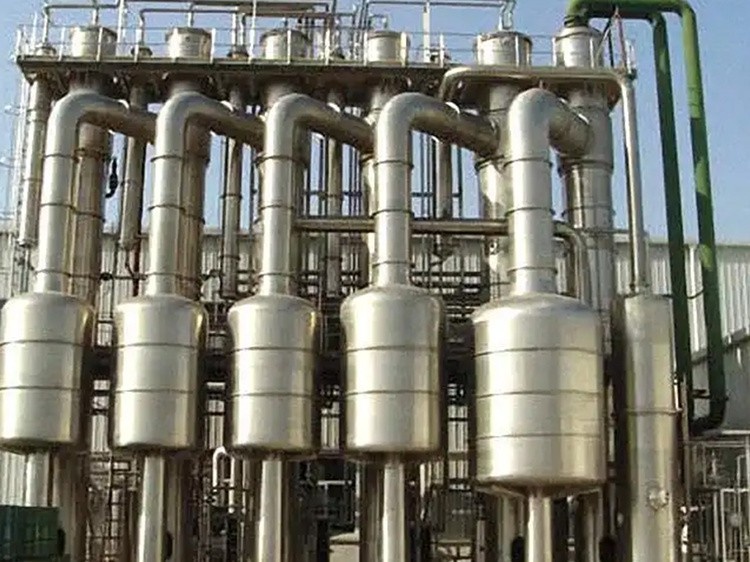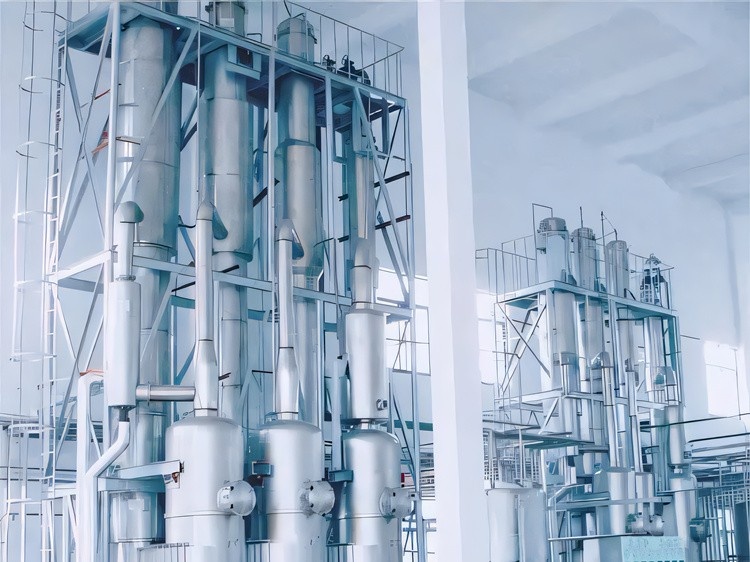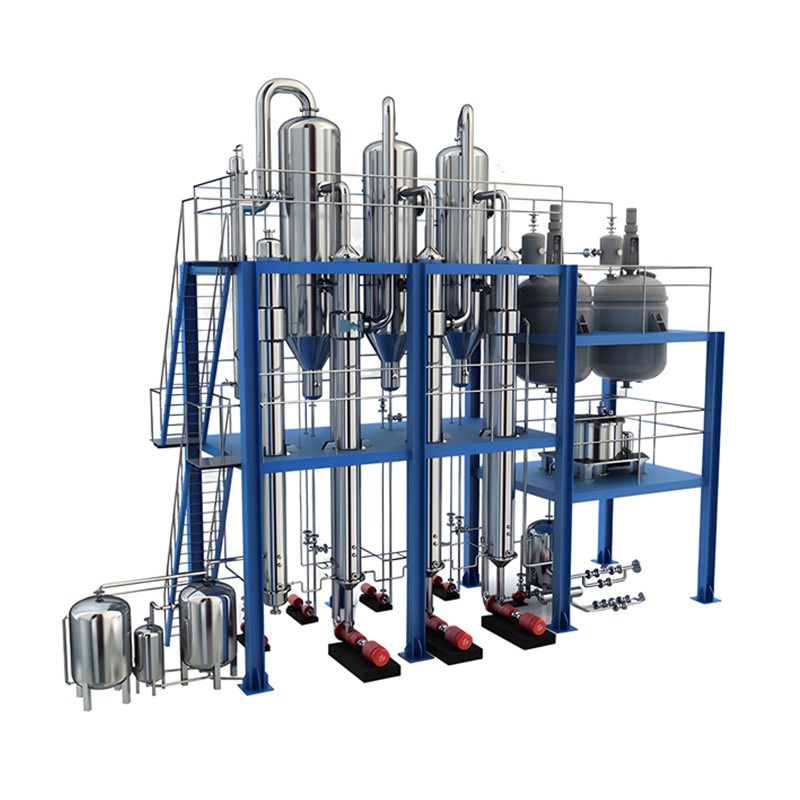
Multi-effect evaporator(MEE) is a high-efficiency evaporation equipment, commonly used to deal with the concentration and dehydration process of large quantities of liquid. It adopts high-efficiency heating system and circulating system, and utilises the principle of multi-stage evaporation, which saves energy consumption, improves working efficiency and reduces environmental pollution. Multi-effect evaporation system is widely used in modern chemical, pharmaceutical, food, energy and other industrial fields.
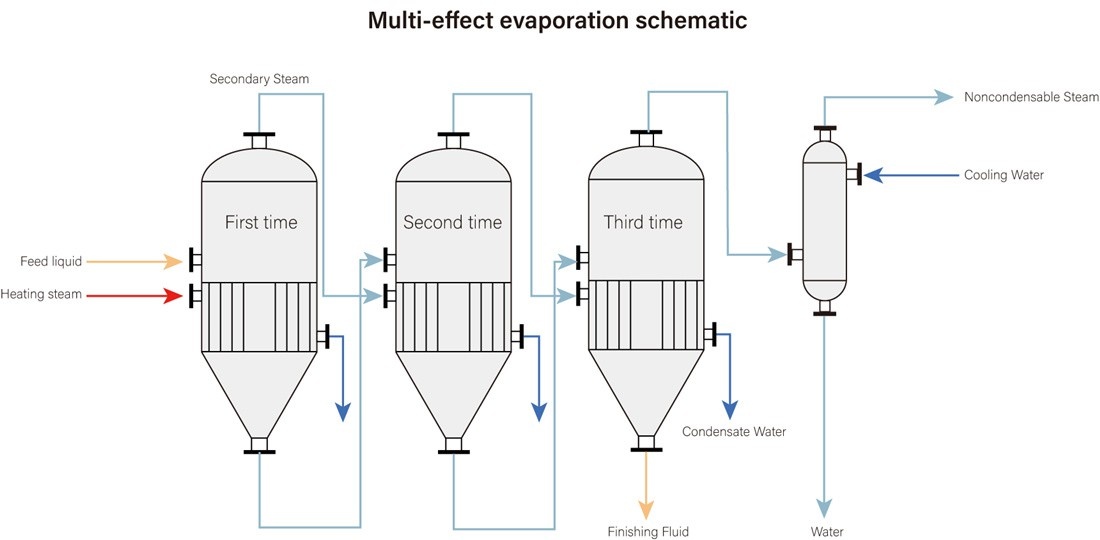
The multiple Effect Evaporator plant / MEE Plant is a heat transfer system composed of multiple evaporators in series. Multiple evaporators are connected in series, the secondary steam of the former evaporator is used as the heating steam of the next evaporator, the heating steam of the next evaporator, and the heating chamber of the next evaporator is the condenser of the previous evaporator, which is the principle of the multi-effect evaporator.
The material that needs to be evaporated is heated by the feed pump into the single-effect heater, and then into the evaporation chamber for evaporation. The gas-liquid separation is carried out in the separator. The solution flows into the inlet of the circulation pump from the bottom of the separator, and is sent into the heater and separator by the circulation pump for circulation flow and evaporation.
In the evaporative heat exchange chamber, latent heat of vaporization is generated by external steam liquefaction to heat the waste water. Due to the large pressure in the evaporative heat exchange chamber, the material is heated to superheat at a pressure higher than the normal boiling point of the liquid in the evaporative heat exchange chamber. After the heated liquid enters the crystallization evaporation chamber, the pressure of the material drops rapidly, resulting in flash or boiling of part of the material aqueous solution.
The steam after the evaporation of waste water enters the two-effect evaporator as a power evaporator for heating, and the unevaporated waste water and salt are temporarily stored in the crystallization evaporation chamber. One effect, two effect and three effect evaporators are connected through the balance pipe, under the negative pressure, the high-salt wastewater or material flows from one effect to two effect and three effect in turn, the wastewater is continuously evaporated, the concentration of salt in the wastewater is getting higher and higher, when the salt in the wastewater material exceeds the saturation state, the salt in the water will continuously precipitate into the salt collection chamber at the lower part of the evaporation crystallization chamber. The whole process is repeated to separate the brine.
The condenser is connected with a vacuum system, and the vacuum system pumps out the uncondensed gas generated in the evaporation system, so that the condenser and the evaporator maintain a negative pressure state and improve the evaporation efficiency of the evaporation system. Under the action of negative pressure, the secondary steam generated by the wastewater in the three-effect evaporator automatically enters the condenser, and the secondary steam generated by the wastewater material is quickly transformed into condensate water under the cooling of the circulating cooling water. The condensed water can be recycled to the reuse pool by means of continuous outlet water.
| Item | NO.1Effect | NO.2Effect | NO.3Effect | NO.4Effect | NO.5Effect |
| Steam Consumption kg/steam kg/water | 1.1 | 0.57 | 0.4 | 0.3 | 0.27 |
| Cooling Water Consumption kg/steam kg/water | 13.5 | 6.75 | 4.5 | 3.38 | 2.7 |
- With steam generation as the main heat source, the more efficiency, the less steam consumption.
- The addition of a steam jet pump is the TVR evaporator, which saves steam more than the multi-effect.
- Evaporator forms have a variety of options, such as forced circulation, falling film, natural circulation, rising film and so on.
- According to the process flow, it can be divided into co-flow, counter-flow, cross-flow, and other forms.